

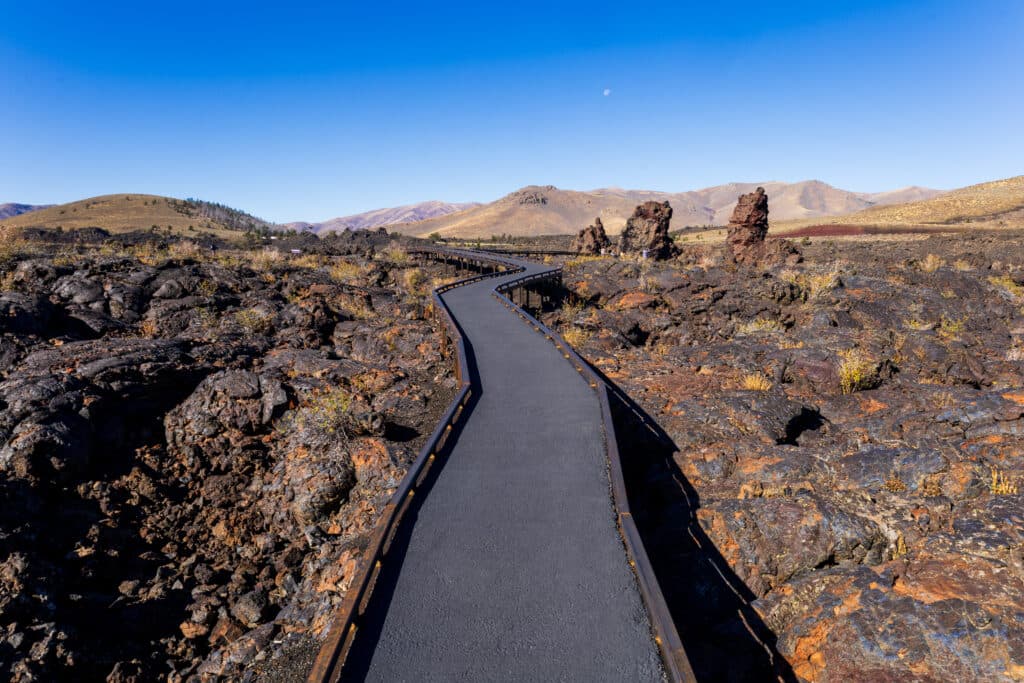
The flow is lava: Craters of the Moon National Monument, in southern Idaho, is made up of acres of black lava stone. Thousands of years ago lava flowed from volcanic eruptions, forming craters, cinder cones, and lava tubes.–discoverwalks.com
You read it first in The Factory in Guide magazine.
Do you ever look at the moon on a starry night? We stare at the moon often in our lifetime. It always looks like a face is looking back. But what looks like parts of a face are actually craters on the moon’s surface. Have you ever wanted to walk on the moon? Only a very few people have had the privilege to do this.
Recently, I heard of a place where you can walk on the “moon”! Well, OK, it is not exactly the moon, but it sure looks and feels like it! If you don’t live in Idaho, you may never have heard of Craters of the Moon National Monument and Preserve. This is a protected area that is roughly the size of the state of Rhode Island that has caves, tunnels and hiking loops.
Three lava fields can be found here. The largest lava field—in the monument and in the continental United States—is the Craters of the Moon lava field. It is made up of about 60 lava flows and 25 volcanic cones that cover 618 square miles (1,600 square kilometers). One of the lava flows is called the Blue Dragon because of its unique blue color.
Another interesting feature of this preserve are the different types of caves formed here. The three most common types are lava tubes, fissure caves and weathered caves.
There are more than 500 known caves, and more are discovered every year. The most common type is the lava tube. The lava tubes were formed when the outside of a lava flow cooled, but the molten river continued to flow on the inside. The lava flowed for miles underground until the source was cut off. This left an empty space. Visitors to the monument can hike to four lava tube caves. Indian Tunnel is the largest of these tubes. It is 30 feet (9 meters) tall and 800 feet (244 meters) long.
The other kinds of caves at Craters of the Moon were either formed in the deep cracks of the Great Rift (fissure caves) or formed when volcanic materials were hollowed out by wind, rain, and frost - these are considered the weathered caves. Today, many of these caves provide refuge for bats and other wildlife.
The Great Rift has some of the deepest open cracks on Earth, reaching down 800 feet (240 m). You can see almost every type of basaltic lava here. There are also cool features like tree molds (holes left by trees burned by lava).
Some of us may never get the chance to go to this extra special place, but if we exercise our faith, we all have a chance to be friends with the One who created the whole universe! And one day, Jesus Himself will come to bring us home to Heaven to live with Him!
"For the Lord Himself will descend from heaven with a shout, with the voice of an archangel, and with the trumpet of God. And the dead in Christ will rise first. Then we who are alive and remain shall be caught up together with them in the clouds to meet the Lord in the air. And thus we shall always be with the Lord." 1 Thess 4:16-17 NKJV
—Carol Lyons, Assistant
Discovery Mountain
Scripture taken from the New King James Version, Copyright 1982 by Thomas Nelson. Used by permission. All rights reserved.
Learn More About This Fact
For more interesting facts, click on the buttons below!